
Loose tools in an open bed cost time on every stop. They slide, they rattle, and they sit in the weather until someone has to dig for the one part the job needs. Truck bed storage systems turn that open space into organized, lockable storage so a work truck can leave the shop ready. The right system depends on the job, not on a catalog photo.
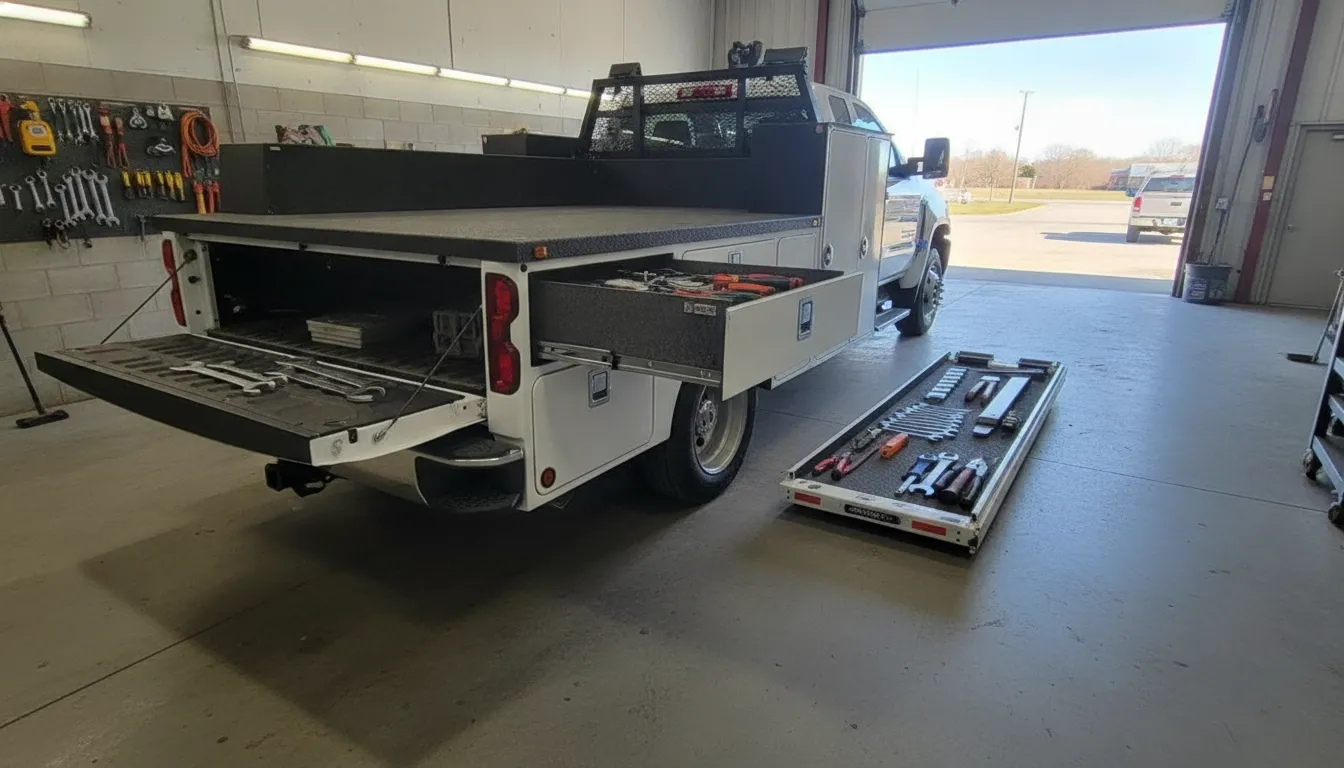
This guide covers the main truck bed storage systems for contractors, field-service teams, and fleets. It compares drawers, sliding platforms, service-truck drawers, and toolboxes by how you actually work. Noble Truck Equipment installs these systems from one shop in Elwood, Indiana, and can match the storage to the rest of the upfit.
What Truck Bed Storage Systems Do
A pickup bed is built for bulk material, not for a tray of fittings. Lumber, pipe, and pallets sit fine in the open. Hand tools, meters, and small parts do not. They shift on every stop, pick up water, and invite theft when the truck sits on a job site. A storage system gives those items a fixed place that locks and, on the better systems, stays dry.
Most truck bed storage systems fall into four groups:
- Full-length drawer systems that sit in the bed and leave a deck on top.
- Sliding cargo platforms that bring the load to the tailgate.
- Cross-bed, side, and under-cover toolboxes for a smaller set of tools.
- Drawer packages built into a service or mechanics body, not a pickup bed.
None of these is a universal answer. A drawer system organizes a service pickup. It is a poor choice if that same truck has to dump gravel or haul a full bed of sheet goods every week. A toolbox keeps a few kits handy and leaves the rest of the bed open. A service body replaces the bed with compartments when the truck is a mobile shop.
Installation is part of the decision. Many drawer and slide systems bolt in and can come out later, but removal is a shop job, not a five-minute change at the curb. Some mounts need holes in the bed. Plan the storage with the liner, the cover, and any hitch or rack so you are not drilling the same truck twice.
How Storage Needs Differ by Job
Start with what the truck carries on a normal day, then on the worst day of the week. A landscape crew and a service technician can both drive a half-ton pickup and still need opposite layouts.
Contractors who haul materials and tools
Builders, concrete crews, and landscape operators usually need both. They carry hand tools, fasteners, and small equipment, and they also need open bed space for bulky loads. A full drawer deck that fills the bed can fight that second job. A cross-bed or side toolbox, or a slide that still leaves height for material, often fits better.
Ask how often the bed has to be empty. If the answer is most days, keep the system easy to work around. If tools ride every day and material rides sometimes, a drawer system with a rated deck can carry both, as long as the deck rating matches the load. Noble does not publish a one-size capacity. Match the product rating to the truck and the load during the quote.
Field-service teams
HVAC, electrical, plumbing, and equipment techs live out of organized kits. They stop often, work from the tailgate, and cannot afford a ten-minute search. Full-length drawers or a sliding platform put parts at the bumper instead of at the cab. Locking matters because the truck sits in driveways and lots.
Weather matters too. Indiana rain and road salt get into an open bed fast. A weather-sealed drawer or a box under a cover protects meters and fittings that a loose bin will ruin. If the tech also carries ladders or pipe, pair the bed system with a rack so long stock does not live on top of the drawers.
Fleets with repeat routes
A fleet wants the same layout on every truck in a class. Drivers should open the same drawer for the same part, and a replacement truck should not need a new habit. Standardize by vocation, not by whatever was on sale. A service route, a delivery route, and a construction route should not share one storage spec.
Fleet planning also includes downtime. Every day a truck sits for a rework is a day it is not earning. Spec the storage with the body, the lighting, and the graphics before the truck goes into service. Noble’s fleet upfitting can coordinate that work, including graphics and delivery, from the Elwood shop for Central Indiana fleets. Indiana, Kentucky, Michigan, Ohio, and Illinois are growth areas, not extra shop locations.
Compare the Main Truck Bed Storage Systems
Use the table as a planning filter before you spend money on a system. It is not a price sheet and it is not a capacity chart. Real fit depends on bed length, cab style, and what else is already bolted to the truck.
| System | Best for | What you give up | Watch for |
|---|---|---|---|
| Full-length bed drawers. | Daily tool and parts kits on a pickup that still needs a flat deck. | Open bed height and easy bulk dumps. | Deck load rating, weather seal, and bed-length fit. |
| Sliding cargo platform. | Heavy or awkward cargo you need at the tailgate. | Some bed depth and a clear tailgate swing. | Slide capacity, one-hand operation, and tie-down points. |
| Cross-bed or side toolbox. | A smaller tool set plus an open bed for material. | Rail space or a strip of bed floor. | Cover clearance, lock type, and whether it blocks a fifth-wheel. |
| Service-body drawers. | A mobile shop that no longer needs an open pickup bed. | The pickup bed itself. | Body compartments, latch security, and crane or liftgate clearance. |
A short way to choose: if the truck is a parts locker on wheels, look at drawers. If the pain is reaching cargo at the cab, look at a slide. If the bed must stay open most of the time, look at a toolbox. If the truck is already a service or mechanics body, the drawers belong in the body, not in a leftover bed.
Drawer Systems, Slides, and Toolboxes
Noble’s tool and storage page shows four lines that map to these jobs. The notes below are planning notes. Product claims such as a lifetime backing stay with that product. They are not a Noble labor warranty.
Full-length drawers
DECKED drawers are a full-length truck bed storage system. The live page describes them as weatherproof, with a reinforced top deck. Noble lists a deck support of up to 2,000 pounds, and 1,000 pounds on midsize trucks. That figure is the product rating on the page, not a promise for every load or every truck. Confirm it against your bed length and what you set on the deck.
Drawers shine when the same tools ride every day. They fail when the truck’s real job is loose bulk that has to come out with a shovel. Do not put a drawer system on a truck that dumps, and do not treat the deck as a dump body.
Sliding cargo platforms
CargoGlide is a sliding platform, not a drawer cabinet. The page describes industrial-grade steel and aluminum, a plywood deck with a thermoplastic surface, roller bearings, and an auto-stop handle so cargo can come out with one hand. It is aimed at heavy hauling you want at the bumper.
A slide is the better fit when the load is bulky, strapped, or too heavy to climb in and lift. It is less useful as the only home for dozens of small parts, because a flat deck does not sort fittings the way drawers do. Some crews run a slide for cargo and a separate box for hand tools.
Toolboxes
Buyers Products toolboxes on the Noble page are weatherproof boxes aimed at contractors, trades, and trailer operators, including boxes that fit A-frame or straight-tongue trailers. A toolbox is the right call when you need a locked kit and you still need most of the bed. It is the wrong call when you are tired of crawling to the front of the bed for a bin that should have been on a slide.
Low boxes can sit under a bed cover. Cross-bed boxes mount behind the cab and use the rails. Side boxes keep a strip of floor clear. Any of them can fight a fifth-wheel, a gooseneck, or a cover, so spec them together. Noble’s truck bed protection page covers liners and covers. This guide does not replace that choice.
Drawers in a service body
C-Tech drawers are built for service trucks, not as a pickup-bed insert. The page describes a full-length handle and dual composite latches that keep drawers locked in transit. They belong on a service or mechanics body, where the compartment is the storage.
Choose this path when the truck no longer needs an open bed. A mechanics body is a mobile workshop. Adding pickup drawers on top of that body usually wastes space and money. If you are still deciding between a service body and a pickup with drawers, that is an upfit question, not a toolbox question.
Plan the Fit Before You Order
Storage fails in the details. A system that looks right online can block the tailgate, sit proud of a cover, or overload a half-ton that already carries a rack and a slide-in. Walk through these checks before anyone orders a box.
- Measure the bed. Length, width between the wheels, and rail height decide which drawer or slide even fits. A short bed and a long bed are not the same part.
- List the daily load and the rare load. Tools every day plus gravel once a month is a different truck than gravel every day.
- Check payload, not just the product sticker. The system, the tools, a rack, and a full fuel tank all count. Noble does not guess remaining payload in a blog post. Bring the door sticker to the quote.
- Decide on weather and locks. Open bins are fine for shovels. Meters, batteries, and customer parts need a seal and a lock.
- Stack the other equipment. Liner, cover, hitch, rack, lighting, and a crane or liftgate all touch the same truck. Spec them once.
- Standardize the fleet layout. Same vocation, same drawer map, so a relief driver is not hunting.
Weight is the check people skip. A drawer system plus a loaded deck can be the right tool and still be too much for that chassis once a plow mount or a lumber rack is on it. Say what the truck does in January and in July. A Central Indiana contractor who plows in winter and builds in summer should not spec storage as if the bed is empty.
Access is the other check. If the driver cannot reach the part without climbing in, the system will not get used. Tailgate access, one-hand slides, and a handle you can work with gloves beat a deeper cabinet you avoid. Put the daily kit at the back. Put the weekly kit forward.
Match Storage to the Rest of the Upfit
Storage is one piece of a work truck. A field truck may also need a liftgate, crane, compressor, or lighting. A fleet may need the same storage spec plus graphics and a delivery plan. Treating storage as an add-on after the body is built is how trucks come back for a second visit.
Noble Truck Equipment configures service, flatbed, dump, mechanics, landscape, and concrete bodies, plus van shelving that is a different job from a pickup bed. Van interiors live on the van equipment pages. This article stays with truck beds and service-body drawers.
Bring three facts to the quote. The truck year, make, and bed length. The vocation and a short list of what must be locked, dry, and at the tailgate. And whether this is one truck or a fleet spec. From there the shop can say whether a drawer deck, a slide, a toolbox, or a service-body package fits, and what has to be installed with it.
There is no public price list for these systems or for the labor to install them. New equipment and installation are custom quotes. Lead time depends on the truck and the product, so ask for the current timing instead of assuming a stock answer.
Request an Upfit Quote for a storage layout that matches the truck and the work.
Frequently Asked Questions
What are the main truck bed storage systems?
The practical set is full-length drawer systems, sliding cargo platforms, cross-bed or side toolboxes, and drawer packages inside a service body. Drawers organize a daily kit and leave a deck. Slides bring heavy cargo to the tailgate. Boxes keep a smaller kit locked and leave the bed open. Service-body drawers replace the open bed with a mobile shop.
Do drawer systems work for contractors who haul bulk material?
Only if bulk hauling is the exception. A full-length drawer system fills the bed and is a bad match for a truck that dumps or carries a full load of material most days. Those trucks usually do better with a toolbox or a slide that still leaves usable bed space. If both jobs are constant, look at a service or combo body instead of forcing a pickup bed to do both.
Will a storage system fit under a bed cover?
Some low toolboxes are made to sit under a cover. Many drawer systems and slides change bed height and will not clear every cover. Measure the closed height and spec the cover, the liner, and the storage together. Noble’s bed protection page is the place to start on liners and covers, and the quote should confirm clearance on your bed.
How should a fleet spec storage across trucks?
Group trucks by the work, not by the cab color. Give each vocation one layout so drivers find the same part in the same place. Include the storage in the original upfit with lighting, racks, and graphics so the truck is not down twice. Noble plans fleet upfits from the Elwood shop for Central Indiana operators.
Can Noble install truck bed storage in Elwood?
Yes. Noble Truck Equipment installs tool storage, including drawer systems, sliding platforms, toolboxes, and service-truck drawers, at 2635 South F St., Elwood, IN 46036. The shop is open Monday through Friday, 8:00 to 17:00. Call the number on the contact page or request an upfit quote with the truck and the job.
Written by Xavier Sequeira, Assistant General Manager at Noble Truck Equipment.